AI automation for student enrollment: a practical guide for 2026
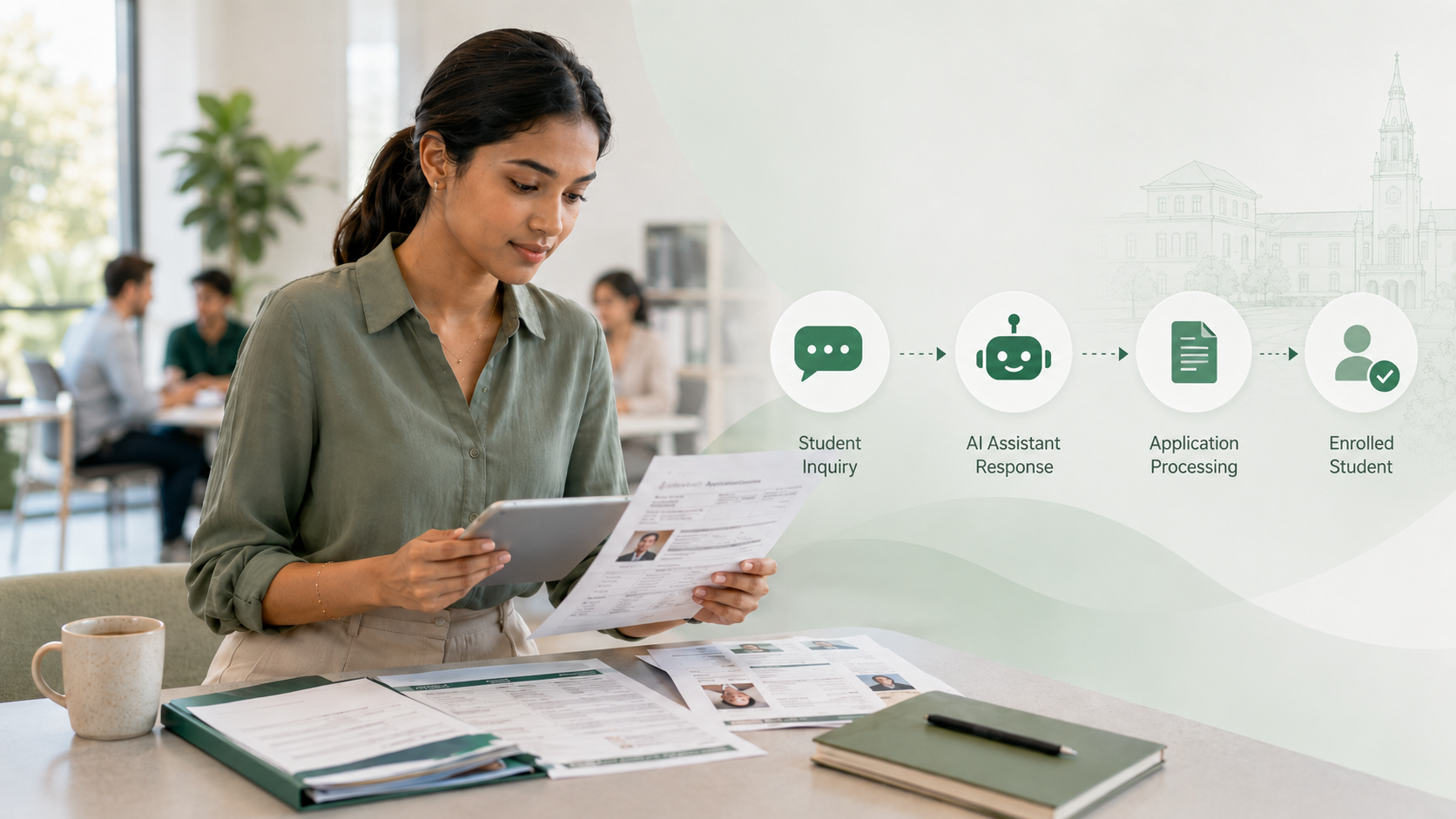
Most institutions don't lose international students to a competitor's better campus or stronger program. They lose them in the inbox.
A mystery shopping study by Edified and UniQuest across 107 universities found that roughly one in five international student inquiries went unanswered entirely. Only one in four students got any follow-up after the first reply. Just over a third said the experience of that first inquiry was enough to make them stop engaging with the institution altogether.
Meanwhile, student expectations run the other way. In QS's global survey of prospective international students, 53% expected an acknowledgment within 24 hours of sending an inquiry, and 21% expected a complete, personal response in that same window.
That gap between what students expect and what admissions teams can physically deliver is the problem AI automation for student enrollment exists to solve.
What AI automation for student enrollment actually means
The phrase gets used loosely, so it helps to separate three layers.
The first layer is basic workflow automation. This is what most admissions CRMs have done for a decade: a form submission triggers an email, a status change triggers a task, a deadline triggers a reminder. Useful, but rigid. Every path has to be mapped in advance, and anything outside the map falls to a person.
The second layer is enrollment marketing automation. Drip sequences, segmentation, lead scoring. This gets communication out at scale, but the communication is templated. A student in Lagos asking about co-op work terms and a student in Hyderabad asking about scholarship deadlines get routed into the same nurture track.
The third layer, and the one worth calling AI automation, is where software understands the inquiry rather than just routing it. An AI agent reads the student's actual question, pulls the answer from the institution's program data and policies, and responds in seconds, in the student's language, at 2 a.m. on a Saturday. It escalates to a human when the question needs one. A scripted chatbot works like a phone tree; this works like a staff member who actually knows the catalogue.
Where automation fits, stage by stage
Inquiry and first response
This is where automation earns its keep fastest, because it's where institutions bleed the most. International students inquire across time zones, and the QS data shows over half expect a response within a day. No admissions team staffed for business hours in one time zone can meet that consistently.
An AI agent handling first response means every inquiry gets an immediate, substantive answer, not an autoresponder saying someone will be in touch. Program details, entry requirements, tuition, intake dates, visa basics. The questions students actually ask are heavily repetitive, which is exactly what makes them automatable.
Application and document collection
Automating the admissions process at the application stage mostly means chasing: incomplete applications, missing transcripts, unverified English scores. Done manually, this chasing eats staff hours and tends to happen in weekly batches rather than the moment a file stalls.
Automation flips that. The system notices a stalled application the day it stalls, nudges the student with the specific missing item, and keeps nudging on a schedule until the file completes or the student opts out. Staff review complete files instead of hunting for incomplete ones.
Offer to enrollment
The stretch between offer and enrollment is where melt happens, and for international students it's the longest and most fragile stage. Visa questions, deposit deadlines, housing, arrival logistics. Students who go quiet at this stage usually haven't picked another school. They're overwhelmed, and nobody checked in.
Student enrolment automation at this stage looks like proactive, personalized outreach tied to each student's actual status: a visa-timeline reminder for the student who hasn't booked a biometrics appointment, a deposit reminder that references their specific deadline, an answer to "can my spouse work while I study" the moment it's asked.
What should stay human
Automation goes wrong when it's used to replace people instead of stripping out the work nobody should have been doing by hand.
Judgment calls stay human: borderline admissions decisions, credential evaluations that don't fit the rubric, scholarship appeals, any conversation where a student is distressed, or the situation is genuinely complicated. A student whose visa was refused doesn't need a workflow. They need a person, quickly, and a good automation setup is what gets that person the context and the time to help.
The honest test for any admissions automation tool: does it hand humans better conversations, or just fewer ones?
How to evaluate admissions automation tools for universities
Four questions cut through most vendor decks.
Does it answer from your data or from a script?
Scripted chatbots deflect. Ask a vendor to show the system answering a question about one of your actual programs, using your actual entry requirements, without anyone pre-writing that answer.
Can it work across languages and time zones?
For international enrollment this is the point. A tool that only performs in English during your office hours automates the part of the problem you didn't have.
Does it know when to escalate?
Ask what happens when a student asks something the system can't answer, or shows signs of frustration. The handoff to staff, with full conversation context attached, matters more than the automation itself.
Does it plug into your existing stack or replace it?
Most institutions have a CRM and an SIS they're not moving off. Automation should sit on top of what you have, not demand a rip-and-replace.
How Capio approaches this
Capio Engage is built specifically for international student recruitment and engagement. AI agents respond to student inquiries instantly and around the clock, trained on the institution's own programs and policies, with escalation to staff when a conversation needs a person. Institutions use it to close exactly the gaps in the Edified and UniQuest numbers above: inquiries that sit unanswered, and students who never hear from anyone again after the first reply.
If you want to see what that looks like against your current response times, book a demo.
Frequently asked questions
-
It's the use of AI agents and automated workflows to handle repetitive admissions work: answering student inquiries, chasing incomplete applications, and sending status-based reminders through to enrollment. Unlike basic CRM automation, AI-based systems understand individual questions and answer from the institution's own data rather than following pre-mapped scripts.
-
First-response to inquiries, follow-up sequences, document and application chasing, deadline reminders, and routine pre-arrival communication all automate well because the underlying questions and triggers repeat across thousands of students. Decisions requiring judgment, such as borderline admits or credential evaluations, should stay with staff.
-
No. It removes the repetitive volume (the same fifty questions, the manual chasing) so staff time shifts to evaluation, complex cases, and conversations that influence a student's decision. The right measure of a tool is whether counsellor conversations get better, not just fewer.
-
A traditional chatbot matches keywords to canned responses and deflects anything unexpected. An AI agent reads the student's actual question, answers from the institution's program and policy data, handles follow-ups in context, and escalates to a human with the full conversation attached when needed.